Showing posts with label 70%-79%. Show all posts

Friday, 25 February 2011

TONKA OF THE GALLOWS (CZECH REPUBLIC/1930/KARL ANTON)

Having made the big move to Prague, a young woman named Tonka becomes a prostitute in order to earn her keep, and quickly becomes integrated into the ways of brothel life. She returns to her countryside home with expensive gifts for her mother, but is evasive about how she acquired the money for them. She also rejoins her lover Jan who proposes marriage, an offer which has clearly been hanging over their relationship for a while. Tonka struggles to deal with her duplicitous lifestyle, and when she agrees to spend the night with a murderer who is condemned to be hanged, she is rejected even by her fellow prostitutes.

From the first moment we see Tonka, she is already a tainted woman, her reputation scuppered by her brothel connections, and as such it is difficult to know which part of her story we are to learn from. If anything, the film appears to tell us, as in Mikio Naruse’s later Morning’s Tree-Lined Street, that the bright lights of the city are a misleading augury. The scenes with Tonka in the countryside are beautiful, pleasant, summery – when the story returns to the city however, we are greeted by nocturnal shadows and noxious smoke. Slovenian actress Ita Rina, best known for her role in Erotikon, does a great job of portraying the protagonist trapped in the evil shadows of Prague. Director Karl Anton employs tropes of German Expressionism and French Impressionism in his visual arsenal, creating a melodrama with surprising emotional reach.


PERFUMED NIGHTMARE (PHILIPPINES/1977/KIDLAT TAHIMIK)

Partly autobiographical, this peculiar independent film from the Philippines reflects on the American influence during the occupation, suggesting where it has benefited his town and where the illusion of goodness is soon to give way. Director Kidlat Tahimik plays a version of himself, a young jeepney driver obsessed with his transistor radio. An avid follower of the Voice of America broadcasting service, Kidlat is heavily seduced by this voice of an apparent higher power, and occupies himself with the dream of being part of the developed world. When he is offered the opportunity to move to Paris, he accepts almost instantly, and soon learns that the Western world operates on more than the icons he had grown up with.

Unapologetically experimental in his storytelling, Tahimik works without any strong semblance of rhythm or pace – pieces of music begin and then are abruptly stopped before the next scene. Dubbing is similarly amateurish, with Tahimik’s character providing a partly diegetic commentary which brings to mind underground filmmakers. This is not to simplify Tahimik’s intellectual goal – if anything, the uneven shooting style and use of bricolage clarify his point, implying that his cinematic voice is an imbalanced compromise as a result of colonialism. Tahimik makes frequent use of visual and verbal puns – the motif of chewing gum plays a metaphorical role, painting the American influence as a fleeting fancy. Perfumed Nightmare lacks the rigour of other post-colonial films such as Soleil Ô, but the personal angle makes this film all the more charming.


Friday, 28 January 2011

HELSINKI, FOREVER (FINLAND/2008/PETER VON BAGH)

In the tradition of films such as Of Time and the City and My Winnipeg, Helsinki, Forever is a sedate mood piece paying tribute to the Finnish capital through fragments of the country’s visual arts. More than just a bricolage piece, the film takes on the structure of a metaphysical journey, links being made between shots, locations, time periods – trams enter screen in the 1930s and leave it in the 1960s. Commentary from a man and a woman (the man’s voice is director Peter von Bagh) propel the visual essay through its twists and turns, only interrupted by smatterings of Finnish pop music.

Peter von Bagh is better known by some as a film historian, and this project displays as deep a love for cinema as it does for Helsinki. Many of the films shown share superficial elements in common – long shadows, minimal movement – and while technical aspects of the film are never brought up, the film functions as a history of Finnish cinema. The one issue here is in the editing – given von Bagh’s access to previously unfamiliar films, one wonders if we’re seeing the clips that best fulfil the film’s intent or if the visual connections are too enjoyable to pass up. In this sense, Helsinki, Forever falls short of the likes of Sans Soleil in creating a compelling film essay, but it nonetheless manages to hold one’s attention. Wistful at times, joyful at others, Helsinki, Forever manages to brim with vivacity through a reconnection with the past.


Wednesday, 26 January 2011

THE MERCHANT OF FOUR SEASONS (GERMANY/1971/RAINER WERNER FASSBINDER)

Freshly returned from a stint in the French Foreign Legion, Hans takes on a lowlier job as a fruit merchant, working under the constant henpecking of his sensible wife Irmgard. An incident involving a past love spurs Hans into a sad routine of nostalgia and self-destruction, punctuated by frequent trips to the bar where he tells anyone who will listen about his former career as a policeman. When Irmgard pushes him too far one night, Hans flips and attacks her with a chair, and the subsequent argument leads to Hans suffering a violent heart attack. The relationship is turned on its head as Irmgard has an affair during Hans’ hospitalisation, raising the ugly issue of trust once again.

The Merchant of Four Seasons marks an evolution in Fassbinder’s style, although vestiges of his sarcastic sense of humour are still palpable. Neither Hans nor Irmgard is a particularly sympathetic character, but their tempestuous relationship is what holds the film together. On the surface the film could be Fassbinder’s twist on the fairy tale, Hans playing a stubby ogre to Irmgard’s svelte princess – at one point Irmgard amuses herself by telling Hans she only really fell for him because of him comical appearance. Indeed the film itself works best as an awkward comedy, despite its serious themes and depressing dénouements. The Merchant of Four Seasons is somewhat reminiscent of Fassbinder’s earlier Why Does Herr R. Run Amok? in its impatient editing, but occasional flashbacks and stronger characterisation allow the viewer enough access.


Sunday, 16 January 2011

BED OF PROCUST (MOLDOVA/2001/VIORICA MESINA, SERGIU PRODAN)

Based on the Camil Petrescu novel of the same name, Bed of Procust concerns a romantic relationship in 1920s Bucharest. Fred pursues a liaison with the vivacious Emilia, but an eventful night together has them lying together in bed, reminiscing about past loves and hidden truths. Fred, reading through love letters, recalls his romance with a young socialite named Madame T, an archetype of femininity, and through flashbacks we see what he gave up for love. Emilia looks back on her time with the deceased Ladima, an old friend of Fred’s, and remembers their incompatibility, and we also learn of her tendency towards promiscuity. In trying to recapture the past, Fred and Emilia are forced to reflect on the future of their current relationship.

With a premise that keeps its two protagonists in a bed for the present time, relating the story through vignettes, Bed of Procust expects a lot from its cast. Thankfully Petru Vutcarau and Tania Popa fulfil their roles as the protagonists, but it is Maia Morgenstern as the seductive Madame T who steals the show, her performance and image channelling the actresses of yesteryear. With the theme of love and romance repeating through the film, it gets a bit cloying at times, sentimental even, but there is a straightness to the whole product that keeps each memory relevant. Full credit must go to husband-and-wife directing team Viorica Mesina and Sergiu Prodan who, in their only film project, do a great job of bringing literature to screen.


Friday, 7 January 2011

THE APPLE (USA/1980/MENAHEM GOLAN)

It’s a futuristic 1994, and the Worldvision Song Festival is underway. Alphie and Bibi travel from their native Canada to participate for their country with a spirited ballad, only to be met with consternation from the sizeable audience, who have had their expectations raised by the glitzy stage histrionics of the BIM, a heartless music corporation which will stop at nothing to win. Alphie and Bibi soon find themselves subsumed by BIM’s record label, and for a while Bibi rides the crest of celebrity. Learning the sinister truth about BIM, Alphie tries his hardest to liberate Bibi from the clutches of BIM’s leader Mr. Boogalow.

With a central concept based on a Eurovision Song Contest of the future, one has to expect an overdose of camp from The Apple, and by golly it delivers. From the glittery triangle appliqués to the abundance of gold, The Apple appears to be picking up on the extravagances missed out on by previous musicals, even outkitsching Rocky Horror Picture Show in its caricatures of the entertainment business. The allegory of sin is obvious but restrained, the apple motif only whipped out for a particularly saucy number, although the film’s conclusion takes on an overtly religious angle which almost substracts from the fun. Regardless of one’s susceptibility to this sort of film, The Apple is very impressive for its sheer scale and design, and it’s a shame it still hasn’t quite had its day. Look out for blink-and-you’ll-miss-it cameos from Miriam Margolyes and Yma Sumac.


Friday, 24 December 2010

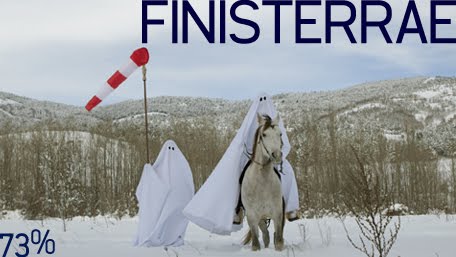
FINISTERRAE (SPAIN/2010/SERGIO CABALLERO)

Opening on a sinister static shot of police tape, Finisterrae tells the bittersweet journey of two ghosts who lose their way. Our two protagonists have recently died, and are acclimatising to their new status as ghoulish members of the undead. With one horse between the two, they embark upon a journey along the well-carved pilgrimage route The Way of Saint James. Stops are afforded for ‘practicalities’ such as fishing and keeping warm by a campfire (although it is never explained why the ghosts need either of these). Their journey brings them many surreal moments such as a trip through a forest of speaking trees and an intimate ghostly striptease to an organ piece that wouldn’t be out of place in an early Disney short.

Created by Sergio Caballero for Sonar, the festival he co-directs, Finisterrae was originally shown in episodes but was later released in cinemas in its entirety. Though one is meant to expect a certain stoicism from the themes, the film is not without its own sense of humour, although most of this is derived from breaking the sombre tension that dominates. There’s an eclectic soundtrack at work here, including Nico and Suicide (this was made for a music festival, after all), but often it adds nothing to the story or the characters. Stunningly shot by photographer Eduard Grau on a range of stunning locations, the film is hard to resist visually, and could almost be the colourful cousin to Albert Serra’s Birdsong. A peculiar but amusing journey.


Thursday, 2 December 2010

INLAND (ALGERIA/2008/TARIQ TEGUIA)

While on a mission to provide electricity in a deserted area of west Algeria, topographer Malek discovers a community damaged by the religious intolerance of Islamic extremists. After encountering many of the local representatives, ranging from policemen to shepherds, Malek realises that the task at hand involves repairing more than just electricity. Over the course of a few evenings, Malek finds himself awoken by explosions, said to be cicadas landing on mines in the area, but a daytime investigation reveals another issue – refugees. When one woman attempts to hide out in Malek’s base camp, she unexpectedly draws him into a wild journey across the country, driven only by a desire to be lost and forgotten. The film is punctuated by darkly lit flashbacks to debates about class division and society’s priorities,

What grabs you immediately about Inland is the soundtrack, ranging from Afrobeat and raï to ambient electronica and indie rock. But although the diverse musical choices each add their own touch to the film, its most powerful moments are those which approach silence, a neat contrast with the wordy evening debates which sit awkwardly between scenes. The film eschews aesthetic complexity in favour of a more direct, realist approach – one particularly strong shot takes the journey of a train, inviting the viewer to survey and assess the landscape as is Malek’s responsibility. Reminiscent of Waiting For Happiness, Touki Bouki and even the exoticism of Woman of the Dunes, Inland is a bold drama with a subtle yet seductive rhythm.


Thursday, 25 November 2010

PIONEERS IN INGOLSTADT (GERMANY/1971/RAINER WERNER FASSBINDER)

The first of Fassbinder’s films to receive significant critical attention, Pioneers In Ingolstadt concerns the construction of a bridge in a German village, spearheaded by a select group of soldiers. Our protagonist of sorts – the story jumps between various characters – is Berta, a reserved young woman who falls almost instantly for a soldier named Karl. Unlike her vampish friend Alma, Berta struggles with sexuality, and her romantic manner jars with Karl’s impatience. Alma, on the other hand, is content to manipulate the men to feed her desires, and by her own assertions is ‘well-liked’ by the visiting soldiers. Before long, the task at hand is forgotten in a long weekend of debauchery.

The film is an adaptation of a play by Marieluise Fleißer, and carries much of the expected theatricality in its mise-en-scène. Fassbinder’s angle on the play is led by gender stereotypes, and he uses his burgeoning film style to experiment with these conventions. The soldiers’ presence in the town is seen as intrusive, almost unwanted, but charged with erotic potential. Men are simultaneously portrayed as heroes and beasts, lycanthropes whose desires get the better of them at night, while the women’s envy is borderline Freudian. The bridge, too short to necessitate much attention, provides a symbol for the relation between the military and small-town Germany, while another motif, a moonlit park bench, provides a setting for various dalliances, sexual and romantic. It might not be a classic, but Pioneers In Ingolstadt is vital viewing for the Fassbinder fanatic.


Tuesday, 23 November 2010

KISSES (JAPAN/1957/YASUZO MASUMURA)

After a bizarre encounter visiting their respective fathers in prison, teenagers Kinichi and Akiko fall into a troubled relationship that leads them deeper than they bargained for. Having won money on a bet at the races, the pair confide each other’s money woes, learning that their priorities lie on rescuing their fathers. Kinichi is determined to make bail of 100,000 yen for his father, who has been imprisoned for election fraud, and realises that he will have to call upon his estranged mother for help. Akiko decides she must pay back the 100,000 yen of public funds that her father embezzled, but her job as an artist’s model fails to fetch enough to cover her mother’s hospital bills, let alone her father’s release.

For those familiar with the work of Yasuzo Masumura, Kisses might feel a particularly tame debut film, but that’s not to say it lacks his flair. Though not exactly the twisted duo of Nagisa Ôshima’s Cruel Story of Youth, Kinichi and Akiko’s forced independence seems representative of the post-war period, but Masumura allows his characters to enjoy the freedom they are also given by their circumstances. A sequence at the beach allows the young couple to experience the simple joys of being a teenager, before the streets of town remind them of their harsh reality. There are some superb shots too, particularly as an untethered camera follows the couple as they motorcycle to the beach. The story might be forgettable, but it’s hard to finish Kisses unmoved.


Saturday, 20 November 2010

VIOLETTE NOZIÈRE (FRANCE/1978/CLAUDE CHABROL)

Fourteen-year-old Violette is the rebellious daughter of a 1930s bourgeois family, already competent at manipulating adults despite her immaturity. Dressed in head-to-toe fur, she sneaks out of the house to bars where she works as a prostitute, using her earnings to fund her partner’s spending habits. When the family doctor reveals that she has syphilis, Violette manages to turn the situation to her advantage by claiming her parents gave her the disease genetically. In a cold-hearted decision, Violette dupes her father into drinking poison so that she can falsely accuse him of molesting her. As her situation worsens, she learns the hard way that every action has its consequence.

A precursor to the early works of Michael Haneke, Violette Nozière is an unusually disturbing social drama, its characters too gullible to defend themselves. Isabelle Huppert is astonishing as the titular character, a believable enfant terrible considering her age at the time (twenty-five), and a stunning cinematic presence as ever. Director Claude Chabrol is subtler than his contemporaries in his treatment of the bourgeoisie, but his target is still clear, particularly in the reaction of Violette’s parents to her syphilis. Chabrol equates precocious sexuality with criminal behaviour, but simultaneously identifies the issues with chastity in modern society. Perhaps the biggest flaw with the film is its rhythm – Violette’s contempt for her parents isn’t sufficiently substantiated – but the Freudian overtones keep the action convincing even at its strangest moments. An underrated oddity, Violette Nozière is a film not to be taken lightly.


Tuesday, 26 October 2010

LEMMINGS, PART 1 - ARCADIA (AUSTRIA/1979/MICHAEL HANEKE)

Shot in two parts, this early Michael Haneke film follows a group of teenagers living in a small Austrian town in the fifties. After a startling opening shot of a car being vandalised, the film begins with something of a montage, presenting the film’s characters as they do their best to live up to their parents’ bourgeois ideals. As the film continues, cracks start showing in the kids’ polite façade – cigarettes are smoked in private, couples are having pre-marital sex, friends turn on each other – and any attempt of intervention by their parents only widens the generation gap.

A closely autobiographical piece (Haneke grew up in post-WWII Austria), Lemmings, Part 1 is an astute exploration of society’s influence on the developing minds of impressionable teenagers. The film is careful not to present them as reckless monsters – on the surface they appear all manners and sweetness, and their negative behaviour feels like a helpless metamorphosis rather than rebellion. These children’s violent impulses are made all the more terrifying by the fact that they are not yet equipped to understand their motives, meaning that this transformation is beyond their, or anybody’s, control. This theme is adeptly explored in Haneke’s latest film, The White Ribbon, the setting transposed to pre-WWI Germany. One can perhaps recognise this as Haneke’s own anti-war message, the suggestion being that it reinstates people’s class status and breeds conflict in every level of society. An accomplished precursor to Haneke’s later masterpieces, Lemmings, Part 1 could easily be Austrian Graffiti.


Sunday, 24 October 2010

THE MILK OF SORROW (PERU/2009/CLAUDIA LLOSA)

Referring to both folk culture and recent Peruvian history, The Milk of Sorrow follows Fausta, one of many women experiencing a psychosomatic affliction which transfers the trauma of systematic rape from generation to generation through women’s breastmilk. Conscious of the suffering endured by her recently deceased mother, Fausta becomes determined to avoid the same fate by inserting a potato in her vagina. As she attempts to sustain her family’s interest in burying their mother according to her wishes, she juggles diverse emotions and slowly deteriorates under the mounting stress.

From the very first frame, director Claudia Llosa makes the audience aware of the film’s themes as Fausta and her dying mother sing an emotive Quechua folksong together. As the rest of her family show more interest in partying, we are kept very aware of Fausta’s spiritual connection with her mother, and thus ideals of femininity. Without featuring any visual depictions of rape, Llosa does a stunning job of eliciting a strong emotional response from her audience, and remarkably even manages to balance the drama with a few laughs at the simple joys of life. But there is a worry that Llosa is oversimplifying the issues. Extreme contrasts in the film are made between masculine and feminine, rich and poor, and in the moments where the film should become most affecting, it often resembles a Greek tragedy. The biggest credit for the film undoubtedly belongs to lead actress Magaly Solier, whose enigmatic performance as Fausta keeps the film fascinating and believable.


Sunday, 12 September 2010

NOTHING PERSONAL (NETHERLANDS/2009/URSZULA ANTONIAK)

Sat by her window on a busy day, a red-haired woman named Anne observes the pedestrians and café dwellers outside. This is the final snatch of urbanity for her before she sets off hiking in the rugged moors of Ireland. On her travels, she bewilders tourists who witness her eating leftover food pilfered from bins, and throws off the lecherous gestures of a truck driver who picked her up by screaming like a banshee. Clad in unoffensive neutral colours, Anne appears to be at peace in the presence of untouched nature, but at the discovery of a seemingly unoccupied lake house she finds herself bothering the occupier, a widower named Martin, for bed and board. Martin accepts on the condition that she assist him in his gardening, beginning an unusual relationship that approaches something like mutual solitude.

Transnational director Urszula Antoniak sidesteps the obvious option of making Anne (or even the entire film) mute in order to hit home her isolation, but the character’s refusal to divulge information about herself, coupled with her hard-to-place accent and fiery disposition, depicts her as an untamable sprite figure. Little is revealed about Martin either, and in this way the two have an unspoken understanding, one that the audience can latch onto the moment the characters realise a shared taste in music. It’s a film one could imagine Michael Winterbottom making in a slow year, but Antoniak shows only enough of her story to leave the viewer wanting to revisit it again and again.


Thursday, 9 September 2010

BLACK SILK (THAILAND/1961/RATTANA PESTONJI, RATANAVADI RATANABHAND)

Prae is a widow who has consigned herself to wearing a funereal black silk dress since the death of her husband. Her relationship with boyfriend Thom is constantly strained by her refusal to live a life outside the house, but it takes a turn for the worse when Thom is involved in a carefully choreographed murder scheme with his boss Seni. Heavily in debt to his rival Wan, Seni assumes the identity of his recently deceased brother to start life afresh, only to learn that Wan is orchestrating the situation to his own advantage. The proceedings have serious ramifications for Prae who, avoiding the heartbreak of a second bereavement, leaves Thom in favour of religious sanctuary.

Though frequently acknowledged as Thailand’s first film noir (‘noir’ is a bit of a misnomer here as each scene is a rich tapestry of colour), Black Silk has more poignancy than the average thriller, contrasting the metropolitan with the traditional. Certain elements, such as Prae’s position as the widow fallen in with a bad lot, seem to anticipate Đng Nht Minh’s marvellous postwar When The Tenth Month Comes, a film that similarly entertains while retaining a sense of realism in its characters. Action in the film is subverted ironically by the inactivity of the camera – a double murder uses a maximum of three angles, with most of the event being caught in a single take. Full credit must go to Ratanavadi Ratanabhand, who brings to the role of Prae a quiet but persistant elegance.


Monday, 6 September 2010

PHUKET (THAILAND/2009/ADITYA ASSARAT)

Playing like a short version of Lost In Translation minus the laboured stereotypes, Phuket follows Korean pop star Jin as she visits Phuket in Thailand, home to the most adoring chapter of her fanbase. Jin spends most of her time stepping in and out of her chauffeur-driven car, desperate to escape the pressures of fame. Tired of her obsequious translator and assistant, she grows closer to chauffeur Pong, asking him to drive her to quiet, isolated spots. The two converse in broken English, Pong helping Jin relive memories she had on a childhood visit to the island.

The film was commissioned by the Foreign Affairs Ministry of Phuket in the hopes of drumming up tourism for Phuket, and director Aditya Assarat manages to eke out a narrative while maintaining focus on the island’s beautiful scenery. Cleverly using the theme of memories to keep his protagonist travelling around, Assarat colours the film with gentle humour and optimism. Lim Su-jeong, famed for roles in A Tale of Two Sisters and I’m A Cyborg, But That’s OK, has honed a decent American accent and pulls off the sense of the out-of-her-depth pop diva without even singing a note. Veteran action star Sorapong Chatree is charming as the fatherly chauffeur, the antithesis of Jin’s jaded superstar. At thirty minutes, it’s perhaps a little too short to make an impact, and longer than predicted for what is essentially a cinematic postcard. Nonetheless, there is sweetness in every frame, coaxed along by a wistful indie soundtrack.


Saturday, 28 August 2010

SEAGULLS DIE IN THE HARBOUR (BELGIUM/1955/RIK KUYPERS, IVO MICHIELS, ROLAND VERHAVERT)

Seagulls only feature briefly in this landmark Flemish feature, which played at the 1956 Cannes Festival, but their presence provides an important metaphor. Our protagonist is a baby-faced vagrant who emerges mysteriously from the harbour in Antwerp, wandering the streets with little apparent purpose but to find sanctuary. Dressed in a dark body-length jacket, he cuts a sinister figure and many of the city’s residents distrust him based on image alone. During his travels, he manages to establish connections with a few women and a young Francophone orphan. As the city gradually warms to his presence, we learn secrets from his past, and how he ended up as he is.

Considering its aesthetic merits, it is a surprise to learn that this film was helmed by relative novices in the field. The lighting – sfumato in the daytime and chiaroscuro at night – adds great depth to the photography and mirrors the protagonist’s state of mind. Antwerp is more than just the backdrop, and the camera takes every opportunity to drink in its unique architecture – at one point the camera rises above rooftop level to present the city as a whole. Though the film is ultimately about the individual, a whole host of characters is featured to create an understanding of the protagonist’s isolation, and this makes his search for a sense of belonging so poignant. Suave but sensitive, Seagulls Die In The Harbour might not be a particularly vital film, but one would do well to file it under ‘hidden gems’.