Showing posts with label 2010s. Show all posts

Sunday, 6 March 2011

ENDHIRAN (INDIA/2010/S. SHANKAR)

A modern twist on the Pygmalion story, Endhiran concerns the endeavours of Dr. Vaseegran who constructs a high-powered android named Chitti in his own image. Despite sharing the athletic ability of Bruce Lee and the dance moves of Michael Jackson, Chitti is not regarded by the relevant authorities as a valuable contribution to the field as it lacks rational ability or emotions. When Vaseegran transplants a positronic brain into Chitti to help him relate to humans better, he gets more than he bargained for as Chitti’s newfound emotions lead him to develop strong feelings towards Vaseegran’s fiancée Sana. Attempting to win Sana back, Vaseegran foolishly goes into competition with Chitti’s superhuman powers, underestimating the android’s ability to mimic his master’s behaviour.

A huge success at the box office, grossing more than any other Indian film ever, Endhiran covers many genres and feels as if it was designed to entertain the widest range of people conceivable, although whether it fulfilled this goal is another question. Lead actor Rajnikanth, playing both Vaseegran and his robot analogue Chitti, has some great comedic turns but is unable to sustain interest for the film’s 155-minute runtime. For the casual Western viewer, there are plenty of WTF moments – a scene where a naked girl runs into traffic is particularly baffling – as well as a plethora of tongue-in-cheek movie references, although the proviso of satire has not saved the film from accusations of plagiarism. But for all its various flaws, this Kollywood blockbuster has undeniable entertainment value.



Tuesday, 25 January 2011

THE STRANGE CASE OF ANGELICA (PORTUGAL/2010/MANOEL DE OLIVEIRA)

Isaac works as a photographer whose role it is to take the ‘final’ pictures of people’s loved ones. Having been hired by a particularly wealthy family to photograph the body of the recently married Angélica, Isaac finds himself inappropriately fixated on the resultant images. As he attempts to return to normality, heading to vineyards to photograph the local workers, Isaac is constantly haunted by the image of this beautiful woman he never knew. His behaviour grows more erratic, and an unfortunate episode during one of his photography expeditions confirms the extent of his manic infatuation.

This being the latest film of many by prolific 102-year-old director Manoel de Oliveira, The Strange Case of Angelica is evidence of a well-lived career in film. De Oliveira establishes mood magnificently, the first ten minutes of the film dominated by the sound and presence of nighttime rain, and a plot about photography gives a great excuse for some superb images of the Douro countryside. With the collaboration of cinematographer Sabine Lancelin, who has lensed several of his productions, de Oliveira composes each scene like a tableau, restricting movement to maintain the illusion of a painting come to life. Disappointingly, as with several of the director’s most recent pictures, Angelica is too stoical to convince emotionally, especially in the film’s fantastical moments – for example, Isaac’s imagined meeting with Angélica comes off more farcical than magical. Though not totally devoid of enjoyment, Angelica requires considerable patience, and the third act is likely to leave one wanting.


Friday, 24 December 2010

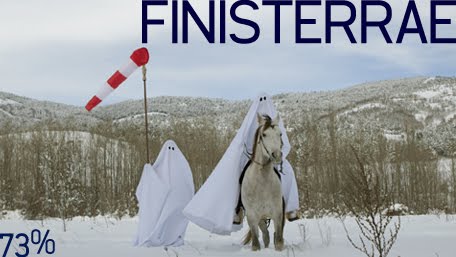
FINISTERRAE (SPAIN/2010/SERGIO CABALLERO)

Opening on a sinister static shot of police tape, Finisterrae tells the bittersweet journey of two ghosts who lose their way. Our two protagonists have recently died, and are acclimatising to their new status as ghoulish members of the undead. With one horse between the two, they embark upon a journey along the well-carved pilgrimage route The Way of Saint James. Stops are afforded for ‘practicalities’ such as fishing and keeping warm by a campfire (although it is never explained why the ghosts need either of these). Their journey brings them many surreal moments such as a trip through a forest of speaking trees and an intimate ghostly striptease to an organ piece that wouldn’t be out of place in an early Disney short.

Created by Sergio Caballero for Sonar, the festival he co-directs, Finisterrae was originally shown in episodes but was later released in cinemas in its entirety. Though one is meant to expect a certain stoicism from the themes, the film is not without its own sense of humour, although most of this is derived from breaking the sombre tension that dominates. There’s an eclectic soundtrack at work here, including Nico and Suicide (this was made for a music festival, after all), but often it adds nothing to the story or the characters. Stunningly shot by photographer Eduard Grau on a range of stunning locations, the film is hard to resist visually, and could almost be the colourful cousin to Albert Serra’s Birdsong. A peculiar but amusing journey.


Sunday, 7 November 2010

SKELETONS (UK/2010/NICK WHITFIELD)

Davis and Bennett are agents for a company known as Veridical, whose business it is to remove skeletons from people’s closets, performing a new age ritual before embarking upon a time-travelling fact-finding mission. One such assignment puts the boys to work at the countryside house of Jane Baron, a presumed widow who has resorted to digging up the grounds to find her missing husband. Jane’s taciturn daughter Rebecca, upset by the men’s presence, tries to disrupt the procedure to preserve the memory of her father, while Davis’ prickly disposition and preoccupation with a snapshot of his own past keep him from doing the job properly. When the investigation comes to a head, both men realise how much of themselves they sacrifice by exploring other people’s pasts.

Developed from a ten-minute short, Skeletons is a surprisingly successful mix of uniquely British humour and sincere existentialism, fostered by a team of people who clearly cared for their creation. First-time director Nick Whitfield is cautiously subtle with the set-up and the eventual pay-off, and the motif of Davis’ treasured memory is a sentimental touch, rather than the fairground attraction it would have been in Inception. Comic duo Ed Gaughan and Andrew Buckley, in the roles of Veridical’s metaphorical ghostbusters, work brilliantly off each other, both rotund (in conflict with the film’s title) but vastly contrasting in personality. There are points in the film where one wishes the edits would slow down, but ultimately the film affords enough room for every type of moviegoer.


Thursday, 14 October 2010

THE HOUSEMAID (SOUTH KOREA/2010/IM SANG-SOO)

In the first five minutes of Im Sang-Soo’s remake of the home invasion classic The Housemaid, a young woman throws herself off a tall building while much of the city goes about its duties unperturbed. With this shocking opener, it feels as if Im is showing he is prepared to match the bravado of Kim Ki-Young’s original, but rather than just recontextualising the story, he shifts the elements around to make a completely new film. Euny takes on a job assisting an older housemaid working for an extremely rich family, but as she is quickly made aware of her inferior class status, she finds herself vulnerable to the advances of the patriarch, Hoon. What he had anticipated to be a casual affair goes terribly awry when Euny falls pregnant, and the family suffers under a mêlée of secrets and lies.

Im has turned the power structure of the original on its head, perhaps in order to reflect a similar change in Korea’s class divide. Whereas the maid of the earlier film exerts predatorial tendencies over the family, Euny is a tabula rasa for her employers to spoil. Im’s parody of upper-class lifestyles is somewhat overwrought, to the exclusion of much-needed characterisation, but the carefully designed household provides many opportunities for clever theatrical camerawork, often emphasising the hierarchy amongst the characters. Unfortunately, the film soon loses its grip on the viewer as the drama grows more intense, particularly as there is very little of the titular character to grasp onto emotionally.


Wednesday, 11 August 2010

GAINSBOURG (VIE HÉROÏQUE) (FRANCE/2010/JOANN SFAR)

A young schoolboy with prominent ears walks through the Paris streets. After he catches sight of a crudely drawn anti-Semitic propaganda poster, he unwittingly wills it to life, taking it on as a cynical sidekick named ‘The Mug’. Such whimsy is the language used by comic-book artist Joann Sfar as he portrays the story of Lucien Ginsburg, better known to the world as Serge Gainsbourg. The women in Gainsbourg’s life interact with this grotesque caricature as if it were still a part of him – until, that is, he settles down with English actress-singer Jane Birkin. Divorced from his alter ego, Gainsbourg’s work grows more fiercely political and his relationship crumbles, but a brief flirtation in a club appears to put him back in the right direction.

Though it certainly captures some of the essence of Gainsbourg’s haphazard life, Gainsbourg (Vie Héroïque) is a confusing extravaganza that rushes straight past emotion in order to keep the audience’s visual interest alight. Sfar might have been showing only the moments that Gainsbourg would have wanted to remember, but the film quickly grows frustrating as key moments in his life are compressed into ten-second shots. One doesn’t doubt that Gainsbourg must have had fond memories of his seduction of Brigitte Bardot, but for this affair to be given more screentime than his parents’ deaths combined seems almost disrespectful. An array of superb performances, helmed by Gainsbourg doppelgänger Éric Elmosnino, keep the viewer’s attention, but the film itself lacks the impact to leave an impression.


Monday, 15 February 2010

ME, MYSELF, AND MY THIRD EYE (USA/2010/ADAM COOLEY)

Made on a budget of $0, Adam Cooley’s Me, Myself And My Third Eye is an unusual exploration of the self, which nominally deals with the exploration for God. Cooley himself portrays four diverse characters, all of whom have their own need for religious experience. An unremarkable hand-puppet of a cat (basically a drawn-on paper bag) purposelessly explores various parts of the house, a masked maniac finds himself jealously coveting an electrical socket, the masked wife of an unnamed president ruminates over possible visits to the sperm bank, and an abrasive rapist father recounts uncaringly how his daughter works as a phone sex operator to fund his heroin addiction. The film flips indiscriminately between the stories.

Naturally, a non-existent budget provides stringent limitations, but it seems that Cooley wasn’t competent to begin with, as the sound and image editing attest. One also wonders whether he set out to spend most of the film in his bedroom, or if it was just easier that way. Fluxus it ain’t, but perhaps it is unfair to judge this sort of films so flippantly. After all, this is essentially the digital age’s equivalent to underground cinema, Cooley handling all roles (including promotion) himself. Visiting his website is somewhat encouraging, although he has more to say about his impressively lo-fi methods of filmmaking than what he wants to achieve. As such, Me, Myself, And My Third Eye is tedious and aimless, but the fact that it was made is refreshing enough to warrant further viewing.