Shot on location in the aggressive confines of a mineshaft, Li Yang’s debut narrative feature follows the exploits of Song and Tang, two mine labourers who con young aspirant workers in the city. The men’s scheme involves them claiming that they and their nephew have secured well-paid jobs in a coalmine, but pretending the nephew has failed to turn up. Offering the open spot to a naïve sixteen-year-old boy named Yuan Fengming, they lead him to an illegal mineshaft with the plan of killing him after a few days and making it look like an accident in order to claim compensation. Song is unexpectedly touched by the boy’s childlike appearance and demeanour, and the scheme hits a snag as the two men argue over Yuan’s fate.
Buoyed by strong performances and subtly intrusive sound design (see the opening five minutes for a fine example), Blind Shaft acts simultaneously as an exposé of a shocking practice which has become far too commonplace, and as a universal statement on financial greed. Li himself has stated that the film should not be seen specifically as an indictment on the Chinese work ethic, but its ban in China suggests that the content hits closer to home than expected. Comparisons to the films of Wang Bing, particularly his marathon documentary Tie Xi Qu, may be reductive, but both directors work towards the similar goal of offering an unabashed insight into the ‘real’ China, and as such one could never overstate the importance of Blind Shaft.
Partly autobiographical, this peculiar independent film from the Philippines reflects on the American influence during the occupation, suggesting where it has benefited his town and where the illusion of goodness is soon to give way. Director Kidlat Tahimik plays a version of himself, a young jeepney driver obsessed with his transistor radio. An avid follower of the Voice of America broadcasting service, Kidlat is heavily seduced by this voice of an apparent higher power, and occupies himself with the dream of being part of the developed world. When he is offered the opportunity to move to Paris, he accepts almost instantly, and soon learns that the Western world operates on more than the icons he had grown up with.
Unapologetically experimental in his storytelling, Tahimik works without any strong semblance of rhythm or pace – pieces of music begin and then are abruptly stopped before the next scene. Dubbing is similarly amateurish, with Tahimik’s character providing a partly diegetic commentary which brings to mind underground filmmakers. This is not to simplify Tahimik’s intellectual goal – if anything, the uneven shooting style and use of bricolage clarify his point, implying that his cinematic voice is an imbalanced compromise as a result of colonialism. Tahimik makes frequent use of visual and verbal puns – the motif of chewing gum plays a metaphorical role, painting the American influence as a fleeting fancy. Perfumed Nightmare lacks the rigour of other post-colonial films such as Soleil Ô, but the personal angle makes this film all the more charming.
Set in post-genocide Rwanda, A Love Letter To My Country follows the burgeoning romance between a Tutsi girl and Hutu man, whose lives have undergone vastly different changes as a result of the senseless mass murder. After a particularly impassioned performance in the local choir, Martha is singled out by choirmaster Rukundo, who hopes to get to know her better through a series of dates. When the couple finally get a chance to talk intimately, each reveals their background. Martha has lost almost all of her family to the genocide, while Rukundo was a conscientious objector to his family’s participation in the murders. The relationship endures tribulations as the pair’s families revive old prejudices.
The strength in the film is in not revealing the differences between Martha and Rukundo immediately – on face value, the two are able to get along without issue. Themes of unity prevail throughout the film, although often these are presented as illusions, and the open ending serves only to suggest that there are still repercussions of discrimination. The film is utterly absorbing at moments – some great acting in the scene where Rukundo’s family express their distrust of Tutsi makes for compelling viewing – but there are several flaws which keep the film from achieving its goal fully. Martha and Rukundo’s relationship happens quicker than the audience can fathom, and the film suffers from a few distracting technical shortcomings. Nonetheless, A Love Letter To My Country has great intentions and hopefully augurs well for the Rwandan film industry.
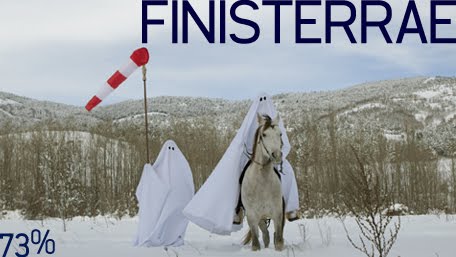
Opening on a sinister static shot of police tape, Finisterrae tells the bittersweet journey of two ghosts who lose their way. Our two protagonists have recently died, and are acclimatising to their new status as ghoulish members of the undead. With one horse between the two, they embark upon a journey along the well-carved pilgrimage route The Way of Saint James. Stops are afforded for ‘practicalities’ such as fishing and keeping warm by a campfire (although it is never explained why the ghosts need either of these). Their journey brings them many surreal moments such as a trip through a forest of speaking trees and an intimate ghostly striptease to an organ piece that wouldn’t be out of place in an early Disney short.
Created by Sergio Caballero for Sonar, the festival he co-directs, Finisterrae was originally shown in episodes but was later released in cinemas in its entirety. Though one is meant to expect a certain stoicism from the themes, the film is not without its own sense of humour, although most of this is derived from breaking the sombre tension that dominates. There’s an eclectic soundtrack at work here, including Nico and Suicide (this was made for a music festival, after all), but often it adds nothing to the story or the characters. Stunningly shot by photographer Eduard Grau on a range of stunning locations, the film is hard to resist visually, and could almost be the colourful cousin to Albert Serra’s Birdsong. A peculiar but amusing journey.
Somehow unrelated to its three predecessors, Silent Night, Deadly Night 4 follows the story of a journalist named Kim who, upon learning of a recent case of spontaneous combustion, decides to launch an investigation into the subject. Desperate to get approval from her boss, she offers to run the story for him, but as usual is pushed to one side. “Boys will be boys,” asserts her straw-haired colleague, but Kim is undeterred and starts researching independently. While at a bookstore, she encounters the proprietor Fima, who takes her to the spot on the roof where the woman had died. Visiting Fima at her home proves to be a wrong move when she passes out and subsequently wakes up to a visceral initiation ceremony involving rats and cockroach larvae.
The theme of Christmas has apparently been waylaid here, with only scant references to religion and the Bible to explain the festive setting. For the most part, director Brian Yuzna gives us gruesome insects with sexual overtones and sham pagan rituals in lieu of a story, Kim’s draw to the pathologically sinister Fima too obscure to be believable. Nonetheless, this fourth instalment in a famously tacky horror series is remarkably entertaining, with some godawful dialogue and subpar acting. Clint Howard, the physiognomically-challenged brother of director Ron Howard, portrays a creepy vagrant named Ricky (most likely a high point in his career), while former Bond girl Maud Adams is hilariously rigid as Fima. Naked Lunch it ain’t, but there’s fun to be had.
One of the more unsettling trends in modern cinema is the pseudo-snuff film, designed to trick the viewer into believing they are witnessing an actual murder. This trend is manifest in Hollywood’s brief obsession with torture porn, but few prominent films have chosen to combine the gore with another contemporary trend, the handheld first-person horror. Enter Korea’s The Butcher, a low-budget independent feature just over an hour in length. The titular character is the pig-masked leader of a group of snuff filmmakers, who keep a selection of victims tied up in a basement in preparation for their films. In between torturing their captives into terrified silence, the group discusses the best ways to profit from their horrific scheme.
Clearly inspired by visceral B-movies and Japanese V-cinema, there is nothing new in The Butcher that hasn’t already been achieved, and one wonders what, if anything, director Kim Jin-Won is trying to say. The film switches between the views of two cameras, one held by a member of the Butcher’s group, the other attached to a female victim. One could be generous and suggest that Kim is making a statement about the sort of viewer who indulges voyeuristically in the genre, but there is too much fantasy in the film’s construction for the director to be excused. To his credit, there are moments where it is easy to forget that this is a fiction film, the low production values adding to the realism, but for the most part, The Butcher deserves no attention.
Opening with a sinister pan across an unidentified goo-spewing organism, Guzoo starts off as innocent as one could imagine. A group of female friends – Minako, Kazuko, Yuka and Mayumi, if we’re being formal – excitedly head for a trip to an isolated house in the country, little knowing what is about to befall them. The owner of the house, one Tomoko Kujo, is a researcher in the laboratory of Dr. Takamura, the archaeologist father of Minako. Once in their separate rooms, the girls experience strange phenomena, and Tomoko begins to get more shifty about the experiments she is conducting in a private room in the house. After Yuka sustains a bizarre injury in the swimming pool, the girls start to distrust their landlady – and rightly so.
Anyone who has seen the cinematic LSD trip that is Hausu might expect something similar from this film as the set-up is almost identical, but where Hausu starts to get hilariously psychedelic at the first hint of terror, Guzoo plays it pretty safe. The main attraction here is the camp design – Freudian tentacles emerge from unexpected places, and the soundtrack is pure 1950s B-movie – as besides that, there isn’t much to write home about. At just forty minutes in length, the film struggles to get the story out before overdosing on special effects. As a relic of low-budget horror in the VHS era however, Guzoo is of immeasurable value, and like the infamous Evil Dead Trap series, could eventually gain cult value through religious rewatching.
A radical work even for Fassbinder’s hefty film catalogue, The Niklashausen Journey darts through history to tell the story of Hans Böhm, a lowly Franconian shepherd who had a visionary experience which instructed him to preach social equality to the masses, calling for the deaths of clergymen and members of the upper class. Böhm, resembling a brightly dressed, long-haired anarchist, finds himself surrounded by a variety of characters from different eras, who appear to be following his life story as it happens. Fassbinder himself plays the enigmatic leather-clad Black Monk, who speaks in curt maxims as he shadows Böhm in his egalitarian mission.
Fassbinder could never be accused of lacking ambition, and in The Niklashausen Journey he becomes his most politically direct. The film uses anachronisms to invite reevaluations of contemporary German politics, with particular resonance with the possible reunification of Germany. He also uses the presence of a medieval peasant amidst modern characters to underline the ridiculousness of revolutionaries comparing themselves to historical figures by dint of their ability to recite ideologies with conviction. One particularly mischievous example sees Böhm preaching Marxist slogans to anyone who will listen, before singing a paean to Lenin. Naturally, a film with such grand aspirations is bound to be uneven, and it is difficult to tell what Fassbinder wanted his audience to make of the characters’ contradictions. As such, it does not have the sincerity of Pasolini’s more overtly political works, sharing more in common with Derek Jarman’s later Jubilee. Uncompromising but unbalanced.
A relic of the Japanese craze for extreme video nasties in the 1980s, Women’s Flesh: My Red Guts eschews any notion of plot, instead displaying the slow, painful suicides of two mentally disturbed women. The film opens with a series of overexposed stills of the deceased women, presumably from a coroner’s camera, although the content of the photos implies an inappropriate sexual fascination with them. We then see the first woman attacking herself with a toothbrush, as if taken over by some demonic force. She then runs a knife around her mouth before slicing through her tongue. The second woman, sat against a black curtain, sits distracted before slowly committing hara-kiri. Hazy black and white interludes add scant detail to the women’s emotional deterioration.
While there have previously been intellectual cinematic explorations into sado-masochistic practices, Women’s Flesh disturbingly appears to be designed solely for thrills and, quite terrifyingly, is not the most extreme feature by infamous director Tamakichi Anaru. Nothing in the film suggests the viewer’s need to ‘understand’ or empathise with these women, their actions little more than a graphic display. Though utterly abhorrent in its themes and purpose, the film is at least interesting for its extremely lo-fi shooting style. VHS artefacts make each image difficult to make out, while a soundtrack of noise and electronic blips adds a supernatural element to the proceedings. Far too pointlessly morbid and puerile to warrant attention, Women’s Flesh is a bewildering bit of VHS-era gore designed merely to shock and disgust.
Best known for his marathon ultra-realist documentaries, filmmaker Wang Bing is representative of the ‘other’ face of China, and his most recent work Man With No Name epitomises this well. The subject of this film not only has no name, he is also ageless, voiceless and of unknown ethnicity. We follow this anonymous man as he goes about his daily duties, supporting his self-sufficient lifestyle on the very fringe of society. One moment, he is digging dirt on a wintry day, the next he is harvesting dung for fertiliser in summer. The man’s abode is a dingy cave of his own making, and while there is the odd echo of civilisation – a noodle packet is seen at one moment – his life is one of absolute solitude.
Though formally simple, Man With No Name is a complex work. We see the nameless man alone on screen, but his story is universalised by the mundanity of his routine, suggesting that there are many others like him. As in his earlier Tie Xi Qu and Crude Oil, Wang does not give his subject much provenance, forcing the audience to relate to him on a basic human level by participating in his lifestyle. It is easy to forget that Wang and his crew are present filming, testament to his artful restraint in the editing process as well as his direct, unpretentious dialogue with his audience. Perhaps dwarfed by the ambition of other Chinese ‘underground’ films, Man With No Name is nonetheless a vital film.
Shot and produced in France by Mauritanian expatriate filmmaker and actor Med Hondo, Soleil Ô has been variously described as the first African avant-garde film and the most significant film made about African émigrés. The abstract film essay, incorporating elements of melodrama and comedy, takes the form of a series of vignettes decrying the treatment of Africans in France. A character seeking employment is met with prejudice and derision from almost everyone, causing him to question the intrinsically French hendiatris of “liberty, equality, fraternity”. Another scene sees a circle of men seek divine forgiveness for speaking in their native tongues, suggesting they could only hope to be granted consideration by Christ once shed of their African identities.
From its bizarre animated opening to its darkly comic subversion of icons (crucifixes are converted into swords at one point), Soleil Ô makes no bones about its agenda and Hondo clarifies the importance of his message through subverting the gaze of the viewer. While the film designates itself as a pamphlet, the focus is more on the reconstruction of identity than the loss of it, and Hondo does not discriminate in his description of blackness. As Djibril Diop Mambéty was to later achieve with his surreal Touki Bouki, Hondo interprets film through the context of African oral storytelling, acknowledging that to recontextualise cinema for an African perspective is to reinterpret the medium. Satirical but fiercely humanistic, Soleil Ô is a film essay whose importance can never be overstated, and deserves a contemporary rediscovery.
A couple on the beach. A bloodied face. A gun. These visual clues form the opening of Harpreet Dehal’s debut film Oceania, produced when he was just 17 years old. The film centres on the relationship between Amy and Steve, two teenagers exasperated by their lives at home. Amy takes a fatalistic approach to her family’s miseries, toying with her suicidal tendencies and burgeoning sexuality, while Steve refuses to dignify his parents’ squabbles with even a word. The pair’s stories are teased rather than told, and the audience is given only enough information to understand the nature of their conflicts.
If the above description has you thinking of a sub-standard Noah Baumbach family dramedy, think again. Using a consistent colour palette of blue and green and a moody (if melodramatic) soundtrack, Harpreet Dehal amplifies his characters’ anguish, and the more elusive the storytelling gets, the more the audience feels sympathy. Camerawork is shaky but purposeful, with many scenes framed asymmetrically to mirror the disequilibrium in the characters’ lives. Perhaps the most impressive aspect of the film is the mature pacing – multiple angles of scenes add dimension to the experience, while patient close-ups eschew action for emotional depth. Though technically precocious, Dehal tries to tackle too many issues at the same time and the result is a little dishonest, particularly in the dramatic moments, but the amateur cast do a decent job of fulfilling their roles. Gentle but touching, Oceania is an episode of teenage angst, culled straight from the source.
Download Oceania at Harpreet Dehal’s website here.
Based on Richard Connell’s short story, The Most Dangerous Game follows a group of people who find themselves on a remote island for different reasons. Eve and Martin are siblings who, alongside two sailors, were the only survivors of a shipwreck. The four have been guests at the home of the Russian Count Zaroff when newcomer Bob, freshly marooned from a shipwreck, arrives on the scene. Bob and Zaroff appear to hit it off quickly, having both made a living through hunting, although Zaroff claims to have found an even more exhilarating prey on the island that he refuses to name. In a matter of days, Martin and both sailors have disappeared, and as Bob and Eve search the house for him, they learn of Zaroff’s horrific pursuit, correctly guessing that they are next in line.
Shot on a budget of $200,000, The Most Dangerous Game turned out to be more bankable than the 1933’s expensive King Kong, with which it shares actress Fay Wray, and certainly rivals it for entertainment value. The set-up is simple but brilliant, and even though the eventual outcome is obvious to the modern viewer, the suspense is kept up at a decent pace. As with many other contemporary films, the acting and screenplay are excessively camp, particularly Leslie Banks’ hammy portrayal of a Russian count, but fans of Béla Lugosi and early B-movies should recognise this is par for the course. Funny and sinister in equal parts, The Most Dangerous Game deserves a revival.
Independent avant-garde filmmaker Adam Cooley has been pulling in the plaudits over the past few years with his uncompromisingly back-to-basics approach, making use of freeware such as MS Paint and Windows Movie Maker to keep his budget at an absolute minimum. Nothing Is More Beautiful Than Nothing is the second instalment of what the director calls his ‘No Trilogy’, a body of work shot in a matter of months and intended to be viewed in one session. The film is a collection of vaguely associated short films produced around the time that Cooley had split up with his girlfriend (to whom the film is dedicated), and she occasionally features. The project is bound together by a gently ambient soundtrack.
While the role of an experimental film is undoubtedly to deflect the viewer from the screen while still holding their gaze, and the bulk of Cooley’s work appears to be designed for this function, Nothing is surprisingly accessible and markedly more direct than his other films. With the self-appointed task of documenting a painful time on film, Cooley sheds some of the layers of punkish deviation and displays himself in an intimate light, although ‘characters’ still exist, including a dragon mask that acts as his advisor. The most touching moments are the simplest – a peculiar riff on Super Mario Bros. comments humorously on gender difference – but Cooley upholds his frenetic editing style, frequently changing the speed of audio. It might not speak to everybody, but Nothing is an unconventionally personal work.
A follow-up to Liu Jiayin’s debut feature, Oxhide II continues the set-up as the director and her parents go about an average day in the house. This time around, the family sit around the table for a dinner of dumplings, discussing problems and the wavering future of their handbag stall. Mother and Father prepare the food at a leisurely pace, perhaps preoccupied with the worries of tomorrow, while Daughter joins in only at the instruction of her Mother. Despite the almost ceremonial diligence the ingredients are treated with, the completed meal arrives on the table with little fanfare, and conversation stays on the subject of Daughter’s inadequacy and clumsiness.
It is easiest to say that Oxhide II is deceptively simple. In keeping her camera static, Liu ensures that the family (and their cats) are the only moving objects, and our focus is thus drawn to their actions alone. Unfortunately, its simplicity is also its downfall, as an attempt to form a more minimalist narrative removes some of the heart that was seen in the film’s predecessor. An exceptionally long take in which Daughter chops vegetables carries a certain cultural relevance as well as establishing her status in the family, but may not have needed to last as long in order to make an impact. Nonetheless, there is something new to Oxhide II as a basic daily ritual is given a feature-length presentation, and the viewer is left to ponder how much one can learn about life if they look closer.
Directed by Hana Makhmalbaf, the 19-year-old daughter of auteur Mohsen Makhmalbaf, Buddha Collapsed Out Of Shame tells the story of Bahtai, a young girl whose dream is simply to go to school. Spurred on by the taunts of her neighbour, she sets out to get herself a notepad and pencil to equip herself for an impromptu trip to the local school. Though unsuccessful in procuring the correct items, she steals her mum’s lipstick to write with and heads out to the school. En route, she is bullied by a group of boys who are pretending to be the Taliban, an experience which distresses her greatly. When she finally gets there, she finds that her dream could never be as good as she had imagined in the current circumstances, and a further encounter with the Taliban boys appears to push her to her limits.
The title makes reference to the Taliban’s explosion of the Buddha statues in Bamyan, and we see first-hand footage of the shocking incident before the first credit is up. Though never sensationalist or sentimental, the film is deeply upsetting for its portrayal of oppression under Taliban rule, and the adults’ lack of presence serves to highlight the issues. Bahtai is portrayed consistently as a child – Makhmalbaf never pretends that she suddenly has the capacity to understand the socio-political gravity of her journey – and it is this that gives the film its strength, particularly as nobody else in the film treats her with appropriate consideration. An important film.
Despite its size, Ethiopia has never experienced a particular boom in filmmaking, with features only occasionally being released. Much of the Ethiopian film ‘industry’ has fallen on the shoulders of ex-pat Haile Gerima, perhaps best known in the West for his historical fantasy Sankofa. While studying at the UCLA, he produced four films, the last of which was a feature called Harvest: 3,000 Years. This film follows an impoverished family as they eke out a life working for a selfish landowner. Though most of the family endure his domineering ways, fully understanding that this may be the only employment that can keep them afloat, daughter Beletech is at odds with her situation, refusing to conform to the landowner’s expectations of her but never gaining fulfillment from doing so.
Harvest carries along at a slow pace, mirroring the endless labour carried out by the family. It is in this respect that the film loses some of its potential as, while the meditative style is beautiful and certainly appropriate, the unprofessional cast are unable to sustain the experience. Additionally, Gerima refined most of the film’s themes in Sankofa, adding a modern context to portray the idea that the suffering never ends. Nonetheless, this should all be forgiven, particularly as Gerima was still a student when the film was completed. The most significant aspect of Harvest is its provenance, having been completed just a year after the fall of Haile Selassie I, and those looking for an honest historical account will be satisfied.
Breakfast is an important meal. It sets you up for the day and gives you the required nutrients, no more, no less - it's a square meal. And this, in a way, is what this film review blog is meant to do. No matter what sort of film it is, every review gets exactly 250 words - just enough to get your RDA of plot, background info and critique.
I try my best to watch and review films from all over the place, in the same way I might have French toast one morning, and Coco Pops the next. Anyway, I'll leave you to get stuck in. Feel free to give me feedback, ask me where to find films, tell me off for unfair comments... I'm all ears. Bon appétit!




 Posts

