Showing posts with label avant-garde. Show all posts

Friday, 24 December 2010

FINISTERRAE (SPAIN/2010/SERGIO CABALLERO)

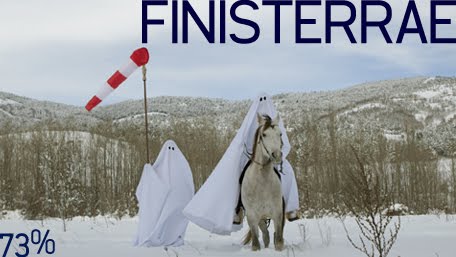
Opening on a sinister static shot of police tape, Finisterrae tells the bittersweet journey of two ghosts who lose their way. Our two protagonists have recently died, and are acclimatising to their new status as ghoulish members of the undead. With one horse between the two, they embark upon a journey along the well-carved pilgrimage route The Way of Saint James. Stops are afforded for ‘practicalities’ such as fishing and keeping warm by a campfire (although it is never explained why the ghosts need either of these). Their journey brings them many surreal moments such as a trip through a forest of speaking trees and an intimate ghostly striptease to an organ piece that wouldn’t be out of place in an early Disney short.

Created by Sergio Caballero for Sonar, the festival he co-directs, Finisterrae was originally shown in episodes but was later released in cinemas in its entirety. Though one is meant to expect a certain stoicism from the themes, the film is not without its own sense of humour, although most of this is derived from breaking the sombre tension that dominates. There’s an eclectic soundtrack at work here, including Nico and Suicide (this was made for a music festival, after all), but often it adds nothing to the story or the characters. Stunningly shot by photographer Eduard Grau on a range of stunning locations, the film is hard to resist visually, and could almost be the colourful cousin to Albert Serra’s Birdsong. A peculiar but amusing journey.


Monday, 20 December 2010

ENTER THE VOID (FRANCE/2009/GASPAR NOÉ)

After the boundary-pushing histrionics of Irréversible, many questioned what exactly Gaspar Noé could do next in an attempt to outdo himself. As a result, his latest project Enter The Void has been hyped to an almost embarrassing degree, with themes of drug addiction and spirituality promising an intense display of zeitgeist. Expatriate drug dealer Oscar lives with his pole dancer sister Linda in a flat in Tokyo. On what appears to be a slow evening at a bar, Oscar is shot by the police, and the story takes a turn as he becomes a floating ghost, able to see but not interact with the world around him. In this spirit form, Oscar seeks to fulfil his childhood promise – to protect Linda from evil.

Although it’s shot entirely from Oscar’s point of view, Noé keeps a lot of the film on the surface, and he frequently repeats symbols as if to remind the audience that this film has profundity. Oscar mentions the Tibetan Book of the Dead, before sinking into a DMT-induced hallucination evoking mandalas. A memory-led narrative full of potential becomes worryingly simplistic with lines like “I promise I’ll never ever leave you”. As proven in Irréversible, Noé knows how to play with his audience, and one must applaud him for some of what he manages to put on screen, but where he might have conceived of his film as a sugary pill designed to cure cinema’s ailments, one can’t help but feel this is little more than a placebo.


Sunday, 14 November 2010

OWN DEATH (HUNGARY/2008/PÉTER FORGÁCS)

In multimedia artist Péter Forgács’ fiction film Own Death, the protagonist is heard and often not seen, presented to the viewer through found footage and photographs as he describes his life after the near-death experience of a heart attack. The protagonist, assumed to be a publisher or printer, is very aware of his physical vulnerability and often refers to his reaction to his environment (sweat and muscular pains being particular favourites). But as he unravels each moment of pain or suffocation, the images suggest a secret joie de vivre, a longing to fulfil the dreams he had almost lost forever. Occasional segments of text, echoing the narration, appear across the screen in a typewriter serif.

Forgács’ interpretation of Péter Nádas’ novella is reminiscent of Peter Greenaway, creating a new text from several existing texts, and the bricolage of dozens of people’s lives hint at reincarnation or a desire to be anyone else. Newly shot footage flows adds motion to an otherwise sedentary slideshow, and intimacy is afforded to images of fingers and faces through use of gentle musique concrète, care of Béla Tarr’s frequent collaborator Mihály Víg. Whether deliberate or not, the narration is frustratingly anodyne and monotone, and one wonders if we are meant to celebrate the protagonist’s ability to articulate his pain, or to merely suffer with him. Moreover, the man’s thoughts often feel repetitive and steal the footage of some great mythic potential. An intriguing experiment, but one that never leaps off the screen as it should.


Sunday, 24 October 2010

23 ZOOMS (GERMANY/2004/GREGORY BÜTTNER)

In documentaries like Capturing the Friedmans, The Devil and Daniel Johnston and Must Read After My Death, home footage and audio recordings are used to emotive, and frequently disturbing effect as they add another dimension to the personal histories of their subjects. In Gregory Büttner’s 23 Zooms, no one person is the subject – in fact, the artist has no connection to any of the people featured. Büttner compiles a selection of twenty-three found photographs and, with no provenance for any of them, composes a piece of music to complement their presentation. Each photograph is scanned over, certain details zoomed into, before fading to black.

While his ambition may not have been to create a tribute to these strangers, Büttner manages to tap into the pseudoscience of nostalgia to give the viewer little shivers that may represent a superficial connection to each photo. A proponent of musique concrète by trade, Büttner has a clear understanding of the synaesthetic possibilities of film, and the lack of movement in each image suggests that audiovisual memory is freed of temporality. Each musical composition feels diligently constructed, and clear references are made to the iconography in the images – a photograph of an old man with canaries is scored by a slightly tropical composition, while a scratched record accompanies Christmas picture. Büttner’s work is very consciously experimental, and ultimately the film showcases the artist’s music over his filmmaking abilities (one wonders why each picture has to seem so sinister), but it is definitely worth a watch.


Wednesday, 8 September 2010

THE NIKLASHAUSEN JOURNEY (GERMANY/1970/RAINER WERNER FASSBINDER, MICHAEL FENGLER)

A radical work even for Fassbinder’s hefty film catalogue, The Niklashausen Journey darts through history to tell the story of Hans Böhm, a lowly Franconian shepherd who had a visionary experience which instructed him to preach social equality to the masses, calling for the deaths of clergymen and members of the upper class. Böhm, resembling a brightly dressed, long-haired anarchist, finds himself surrounded by a variety of characters from different eras, who appear to be following his life story as it happens. Fassbinder himself plays the enigmatic leather-clad Black Monk, who speaks in curt maxims as he shadows Böhm in his egalitarian mission.

Fassbinder could never be accused of lacking ambition, and in The Niklashausen Journey he becomes his most politically direct. The film uses anachronisms to invite reevaluations of contemporary German politics, with particular resonance with the possible reunification of Germany. He also uses the presence of a medieval peasant amidst modern characters to underline the ridiculousness of revolutionaries comparing themselves to historical figures by dint of their ability to recite ideologies with conviction. One particularly mischievous example sees Böhm preaching Marxist slogans to anyone who will listen, before singing a paean to Lenin. Naturally, a film with such grand aspirations is bound to be uneven, and it is difficult to tell what Fassbinder wanted his audience to make of the characters’ contradictions. As such, it does not have the sincerity of Pasolini’s more overtly political works, sharing more in common with Derek Jarman’s later Jubilee. Uncompromising but unbalanced.


Tuesday, 20 July 2010

NUUK (GERMANY/1997/THOMAS KÖNER)

Thomas Köner is a German media artist who works in both video and music, combining the two to create unique ambient experiences. His area of fascination seems to be the North Pole, and all of his installations focus intently on the natural beauty of this area. This project, Nuuk, comprises a series of desaturated images of the Greenlandic capital, ice sheets dominating the screen, and the framing often suggests that these stills could have been culled from CCTV footage. One image, taking in a snow-covered street lined with drab apartment blocks, slowly mutates into a nocturnal scene, coloured lights emerging from windows. The music gently sweeps the viewer through the experience, using a variegated wall of electronically produced tones.

If it had to be categorised, Nuuk would best align itself with the voyeuristic works of James Benning and Sharon Lockhart, its wordless presentation encouraging the viewer to let go of all previous understanding of cinema and enjoy the experience. One is led to feel as if the music is somehow being produced by the ice itself, as there is a deep, raw quality to the soundtrack that defies musical classification, and the texture of the video harmonises with this. Though successful, it is tempting to consider what effect the film would have if there was movement in each ‘still’, for example if a person were to be seen walking through the city scene. Not for the impatient, Nuuk is a twenty-minute film in name only, and deserves one’s full attention.


Saturday, 10 July 2010

NOTHING IS MORE BEAUTIFUL THAN NOTHING (USA/2009/ADAM COOLEY)

Independent avant-garde filmmaker Adam Cooley has been pulling in the plaudits over the past few years with his uncompromisingly back-to-basics approach, making use of freeware such as MS Paint and Windows Movie Maker to keep his budget at an absolute minimum. Nothing Is More Beautiful Than Nothing is the second instalment of what the director calls his ‘No Trilogy’, a body of work shot in a matter of months and intended to be viewed in one session. The film is a collection of vaguely associated short films produced around the time that Cooley had split up with his girlfriend (to whom the film is dedicated), and she occasionally features. The project is bound together by a gently ambient soundtrack.

While the role of an experimental film is undoubtedly to deflect the viewer from the screen while still holding their gaze, and the bulk of Cooley’s work appears to be designed for this function, Nothing is surprisingly accessible and markedly more direct than his other films. With the self-appointed task of documenting a painful time on film, Cooley sheds some of the layers of punkish deviation and displays himself in an intimate light, although ‘characters’ still exist, including a dragon mask that acts as his advisor. The most touching moments are the simplest – a peculiar riff on Super Mario Bros. comments humorously on gender difference – but Cooley upholds his frenetic editing style, frequently changing the speed of audio. It might not speak to everybody, but Nothing is an unconventionally personal work.


Watch the film on Youtube here, or on Vimeo here


Friday, 2 July 2010

ONE11 AND 103 (GERMANY/1992/HENNING LOHNER)

Echoing a lot of the experimentation he had done with music, John Cage’s only feature film project One11 And 103 pares film down to its most basic concepts. The subject here is light itself, the very Urschleim of photography, and its behaviour in the film often runs in counterpoint with an orchestral work that Cage wrote specially for the project. Employing what sound theorist Michel Chion calls ‘synchresis’, the film binds both sonic and visual experiences together through mood and intensity. Though Cage and fellow composer Andrew Culver specifically designed the lighting arrangement so that it would be randomised to some degree, there are several audio-visual harmonies throughout the film. The grain of the film adds an extra urgency to these photographic abstractions.

It would be cliché to call the work ‘brave’ for its simplicity, especially in light of the achievements made earlier by artists like Norman McLaren and Tony Conrad, but there is something excitingly new about One11 And 103, even seeing it 18 years later. Being denied the ability to gauge even space or time in a film is an alienating experience, and this is precisely what Cage and Culver appear to reference in their collaboration. Naturally, it can get quite frustrating to watch, even if one knows what to expect from Cage. The audience is always kept on the surface of the film, but the more open-minded viewer may sink deeper, finding elementary patterns in either the visuals or the composition – this could easily be minimalism’s Fantasia.


Monday, 21 June 2010

CLOSED VISION (FRANCE/1954/MARC'O)

With the advent of cinema, many artists have used this new medium not for theatre, but to attempt to record the human thought process realistically. Surrealism and the avant-garde brought with them editing styles which seem to echo the stream of consciousness. The lettrist movement of the forties and fifties aimed to reduce literature and cinema to its formal fragments, removing any nuance of semantics or grammar. The films produced from this movement still present a heady challenge even today, and Marc’O’s Closed Vision is no exception. A narrator guides the viewer through the film’s intentions as a vibrant array of images is presented. Various photocollages evoke the contorted faces of human emotion, intercut with surreal imagery reminiscent of Buñuel and Cocteau, both of whom endorsed the film.

Apart from the patronising disclaimer at the start of the film which acknowledges the need for an explanation for ‘lay audiences’, Marc’O does a good job of drawing the viewer in, the curiosity of his new film language being a reason to watch rather than switch off. Unlike his lettrist colleagues, Marc’O revels in the possibilities of both image and sound, engendering a sense of discord as the mind tries to follow the two independent strands. The narration plays with the phonetic complexities of language, sounds being stressed and repeated at random, and brings to mind a Beat poetry session. Closed Vision is a little too theatrical to fully follow through with its mission statement, but merits commemoration in experimental film history.


Wednesday, 9 June 2010

7p., cuis., s. de b. ... à saisir (FRANCE/1984/AGNÈS VARDA)

Accompanying a shot of a celestially lit staircase, a man’s voice is heard musing on the suitability of an apartment which used to be part of a hospice. It soon becomes clear that the man is or was an estate agent, recalling the history of previous clients. As he narrates the story of a family who lived in the apartment twenty years ago, we see humans as well as waxwork figures enacting scenes from their life, the rooms decorated with still-life paintings. Colours, textures and lights transform the mood of different scenes, while age is conveyed solely through the faces and bodies of the actors. The film was made in the exhibition space of biologist and artist Louis Bec, who stars in the film as the aging father.

Agnès Varda, a mainstay of the French New Wave, appears to be channelling the Czechoslovak New Wave here, applying a theatrical, surrealistic mode of thinking to her use of the space, and a cheerful demeanour about the morbid subject of mortality. The family’s story is succinctly told through gentle vignettes, the nuclei of which are not solid events, but feelings and expressions. Varda uses different textures not only in the rooms, which are at different times covered in grass, feathers and soil, but also in dialogue – the phonemic richness of the father’s gerontological jargon is later mirrored in the children’s discussion about ‘bad’ words. Visually inventive and bizarrely touching, this Buñuelian short is a minor masterpiece in Varda’s impressive portfolio of work.


Thursday, 27 May 2010

AS I WAS MOVING AHEAD OCCASIONALLY I SAW BRIEF GLIMPSES OF BEAUTY (USA/2000/JONAS MEKAS)

Jonas Mekas is one of the most prolific artists working with film, and even to this day he keeps himself occupied with projects at the grand old age of eighty-seven. His four-hour magnum opus As I Was Moving Ahead Occasionally I Saw Brief Glimpses Of Beauty narrates the past thirty years of his life through a careful compilation of family footage, accompanied by commentary, music and audio clips. Through Mekas’ meticulous editing, positioning disparate events side by side, precious memories lose their preciousness and become performances of ‘real life’ – a family excursion is no longer a fun day out, rather a beautiful silent play of light and colour.

Mekas, a man haunted by the spectre of memory, achieves the rare feat of putting himself on camera without needing to be in front of it. His juxtaposition of images is never gratuitous or sentimental, even as flowers superimpose images of children, and although names of relatives and friends are mentioned, the priority is never to learn exactly what role these people play in his life, rather to learn what sort of people they are or were. Any budding artist working in 8mm and 16mm would do well to watch Mekas’ work to learn how to make true meaning of home video footage. In spite of, or perhaps thanks to its extensive length, As I Was Moving Ahead is a wholly immersive experience – while these may not be memories from our own lives, they will be by the end of the film.


Saturday, 8 May 2010

THE FLICKER (USA/1965/TONY CONRAD)

A handwritten statement at the beginning of The Flicker warns that the filmmakers accept no responsibility for any “physical or mental injury” caused by the film, namely epileptic seizures. A white screen is interrupted by the occasional black ‘flash’ before returning back to white, resulting in a flicker. The switch between the two becomes quicker and more frequent, to the point that it is difficult to judge what is on screen at any given time. The flicker’s hypnotic effect, if one is constantly watching it, can result in colourful speckles known as phosphenes appearing on the eye, leading to potential hallucinations. Shortly after the flicker reaches its peak speed, the film decelerates to a white frame, an abrupt conclusion to a bumpy ride. The unusual synth soundtrack, resembling an electronic scraping sound and a pneumatic drill, accelerates in time with the flicker, enhancing its bewildering effect.

Though its comical warning wouldn’t look out of place at the beginning of a fifties B-movie, The Flicker’s ideology and form align it with some of the best structural films of the period. Artist Tony Conrad’s deceptively simple half-hour short essentially narrates the structure of any film, and as the black and white screens alternate increasingly quickly, they appear to fuse into a steady image, a deception led by the varying speed of the flicker. It may have been repeated countless times since, but The Flicker stands out as a fascinating experiment in consciousness and perception, alongside artist Brion Gysin’s hallucinogenic device, the Dreamachine.

(An interactive flicker-effect experiment can be found here - not recommended for those with epilepsy)


Wednesday, 28 April 2010

LIQUID SKY (USA/1982/SLAVA TSUKERMAN)

On the night of a New Wave fashion show, a small UFO lands in an apartment belonging to Margaret, a drug-addled supermodel, and her dealer girlfriend Adrian. Its occupant, a small, shapeshifting alien, hides in the apartment unbeknownst to the couple, seeking a very unusual source of nourishment. Meanwhile, Margaret is grappling with her cocaine addict rival Jimmy, with whom she has arranged a rooftop photo shoot. At the shoot, Margaret finds herself unwillingly seduced by former drama teacher Owen, who collapses after sex with a sharp crystal protruding from his head. Perturbed by the thought that it was her fault, Margaret falls into a downward spiral, pushing Adrian away for her and unwittingly attracting unwanted attention, but

Made for just $500,000 by Russian ex-pat Slava Tsukerman, Liquid Sky shares similar production values with other low-budget sci-fi or horror films, including a stilted screenplay and lazy acting. Anna Carlisle, in the roles of both Margaret and Jimmy, is more likely to be remembered for being a poster girl for androgyny than a great actress, as her performance is led almost entirely by contrived stiffness. But what the film loses in technicalities, it gains in managing to crystallise the zeitgeist of the eighties, in both its superficial aspects and its deeper sociological implications. In this way, Liquid Sky is ripe for rediscovery – its independent spirit and unique approach to sexuality harmonises well with modern attitudes to cinema, and the hilariously mechanistic, synth-dominated soundtrack is a clear influence on the electroclash genre.

Hear a sample of the soundtrack here


Wednesday, 21 April 2010

LYRICAL NITRATE (NETHERLANDS/1991/PETER DELPEUT)

In his 1991 found-footage project Lyrical Nitrate, filmmaker Peter Delpeut strings together an abstract ode to cinema. The footage, culled from various turn-of-the-century films from the collection of distributor Jean Desmets, had originally been printed on coloured nitrate film stock which has left the images in some way deteriorated. Delpeut arranges his film clips into categories which evoke the experiences of watching film. For example, the first segment, ‘Looking’, sees actors in various films addressing the camera with their gaze, accompanied by a frenzied attack of intertitles in different languages. The film doesn’t follow a strict narrative, although a basic sense of mortality is echoed in its structure.

Though some might say that the similarities between Delpeut’s process and the one Bill Morrison used for his 2002 film Decasia are so close as to suggest plagiarism by the latter, such a question ignores the nature of the found-footage genre. As Jean-Luc Godard once noted, “it’s not where you take things from, it’s where you take them to”. This however does not excuse the two films from comparison. Whereas Decasia creates controlled chaos through its presentation of odds and ends of unknown films, most of them damaged beyond recognition by natural causes, Lyrical Nitrate honours cinema through identifying patterns. Montages of similar clips from different films suggests an element of collective perfectionism, as if filmmakers were constantly collaborating to document life as best as possible. The film’s everchanging colour values have a hypnotic effect, rendering the film a gentle, ghostly experience.


Friday, 9 April 2010

THAÏS (ITALY/1917/ANTON GIULIO BRAGAGLIA)

Vera Preobrajenska is a beautiful countess from an unnamed Slavic land. Taking on the pseudonym Thaïs, the name of an ancient Egyptian courtesan, she makes a game of seducing married men, never once considering their emotions or ever her own. Thaïs is frequently seen surrounded by her admirers, but becomes so dependent on their attention that she is saddened greatly by their departure. Encouraged by positive responses from her various suitors, she takes it upon herself to pursue her best friend’s husband, but the newfound feeling of guilt, added to the suffocating extravagances of her ornate house, prove too much for Thaïs to handle.

Thaïs is the only surviving film from the Italian Futurist movement, and as such has a special importance in the history of cinema. In truth, the film’s virtues lie mostly in its set design rather than the drama or acting, but it is definitely to painter and designer Enrico Prampolini’s credit. Thaïs’ elaborately designed house, filled with secret doors and corridors of indeterminable perspective, is a nightmarish labyrinth of bold geometric shapes, predicting and provoking her eventual downfall. At parts of the film, steam is seen to emerge from holes in the wall. Adding to the phantasmagoria is the yellow tint of the print, which lends the images an almost electric vibrancy. Though its story is instantly forgettable, Thaïs should nonetheless be seen alongside The Cabinet of Dr. Caligari and A Crazy Page, as a reminder that visual ingenuity is as old as the cinematograph itself.


Tuesday, 2 March 2010

WAVELENGTH (CANADA/1967/MICHAEL SNOW)

Comprising one long zoom (in reality, a series of shots stitched together), experimental filmmaker Michael Snow’s best-known work Wavelength centres on a large, mostly empty room. The camera is pointed at four windows on one of the walls, the rest of the space barely relevant. During the zoom, the image undergoes various changes – colour, film speed, focus. The room is occasionally inhabited by people, forming a narrative which is deliberately sidelined, even in light of dramatic events. As the zoom approaches the windows, it settles on a section of wall in the middle covered in photographs. Moving closer still, the camera frames itself on a photo of the sea, so that waves fill the screen. Throughout the film, a sine wave is heard, running the gamut from 50 to 12,000 cycles per second. The sound ultimately synchronises with a police siren, heralding the end of the film.

Wavelength requires a little patience, particularly bearing in mind the alienating sound of the sine wave, but it is undoubtedly a worthwhile experiment. Snow, who is known for playing at length with camera movement, returns film to quasi-purity – the camera is no longer selective, but is reduced to one constant motion, as is the sound. At times, the camera’s transformations render the room unrecognisable – as the image flips from negative to positive, the negative space of the windows almost leaves an imprint on the eye. By pushing the boundaries of the medium, Wavelength gives us an insight of a world between the lines.


Wednesday, 24 February 2010

HATSU-YUME (USA/1981/BILL VIOLA)

Taking its title and cue from the Japanese belief that the first dream of a new year is premonitory, Bill Viola’s masterwork Hatsu-Yume shows the passing of a day over the course of an hour. Playing with video speed, dubbing and lighting, Viola choreographs what must have been a considerable library of footage into a wordless statement about life, inviting the viewer to absorb the tranquil beauty of time passing by. Opening with a dark shot of the tide, the film travels across Japan, taking in sights of land, water, sky and urban space. Details leap out where they wouldn’t have before - the filthy corner of a polystyrene crate, the subdermal iridescence of an octopus, raindrops on a windshield. No overwhelming link is made between sequences, save for the progression of light and the theme of mortality.

Created while Viola was artist-in-residence at Sony in Japan, Hatsu-Yume is, in its own way, thrilling. The static soundtrack, resembling the sound of a distant sea, sustains a dream-like sensation through the film, and allows the boundaries between sight and sound to disappear. When a coin being fed into a vending machine doesn’t clink, it feels as if this action is happening in a world beyond our control. Viola’s exploration of Japan and careful editing display a strong understanding of mono no aware, the Japanese philosophy of the transience of being. Though it should be watched as a projection, this meditative film is inviting enough that it could essentially be watched anywhere.