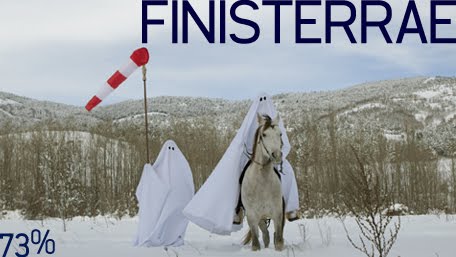
Opening on a sinister static shot of police tape, Finisterrae tells the bittersweet journey of two ghosts who lose their way. Our two protagonists have recently died, and are acclimatising to their new status as ghoulish members of the undead. With one horse between the two, they embark upon a journey along the well-carved pilgrimage route The Way of Saint James. Stops are afforded for ‘practicalities’ such as fishing and keeping warm by a campfire (although it is never explained why the ghosts need either of these). Their journey brings them many surreal moments such as a trip through a forest of speaking trees and an intimate ghostly striptease to an organ piece that wouldn’t be out of place in an early Disney short.
Created by Sergio Caballero for Sonar, the festival he co-directs, Finisterrae was originally shown in episodes but was later released in cinemas in its entirety. Though one is meant to expect a certain stoicism from the themes, the film is not without its own sense of humour, although most of this is derived from breaking the sombre tension that dominates. There’s an eclectic soundtrack at work here, including Nico and Suicide (this was made for a music festival, after all), but often it adds nothing to the story or the characters. Stunningly shot by photographer Eduard Grau on a range of stunning locations, the film is hard to resist visually, and could almost be the colourful cousin to Albert Serra’s Birdsong. A peculiar but amusing journey.
Shot in a gentle meditative manner, Albert Serra’s Birdsong conveys the story of the Three Wise Men journeying to Bethlehem for the birth of Christ. Their travels bring them across breathtaking empty landscapes of all terrains, and only the sound of birdsong is to guide their way. Throughout their journey, the men chat, argue and moan, their crowns losing status as they grow more puerile. Meanwhile, Mary and Joseph have taken shelter in a small hut, where a visual pun involving a lamb suggests that Jesus has already been born. Music is almost entirely absent, save for a flourish at the point of the magi’s arrival.
The plot implies a heavy Pasolini influence, and this is visible in Serra’s handling of the subject matter, but there is something about his version of events. Most notable is the way in which he humanises the Three Wise Men – these aren’t men capable of herculean sufferance, but living human beings, vulnerable to boredom, hunger and thirst. In this way, Serra both demystifies and realises elements of the nativity story, as the magi while away hours with philosophical discussion about the world. It is perhaps most appropriate to say that Birdsong is a magical experience – Serra does not wish to convert, nor is he as cynical as Pasolini. The film’s long takes and extensive silence can make it a trial to watch, particularly as they lack the substance and power of, say, Sátántangó, but that’s not to say it isn’t worth watching at all.
In this introspective documentary about the judicial system in Spain, five people accused of molesting children are put on trial in Barcelona. The scandal, named the Raval case after the neighbourhood in which it took place, rightfully shook the nation to its core. Xavier Tamarit, a soft-spoken schoolteacher who stands accused of prostituting several children under his care, appears disturbingly unaffected by the charges launched against him, explaining himself without emotion. Director Joaquim Jordà compiles news reports, interviews and even performance art related to the case to illustrate the impact of the case on the media.
By subject matter, this sits alongside Capturing The Friedmans and Paradise Lost, but in opposition to these films, About Children presents the facts without breaking the fourth wall, as if not wishing to sensationalise the case any further. In some ways however, Jordà’s work trivialises aspects of the case – the film is as much about the Spanish judiciary as it is about paedophilia, and while the theatre pieces and acoustic soundtrack may help to form filmic interludes, they are discordant with the serious nature of the trial and appear insensitive. This is not to say that the film doesn’t take its subject seriously. The cameraman seem to be everywhere in the courtroom, absorbing natural reactions from attorneys and jury members, as well as profiling the accused without interfering with procedure. Shocking, challenging and thought-provoking, About Children is a hard-hitting analysis of an abhorrent crime, an incisive study into the darkest side of human nature.
While on his way to work, phlegmatic salaryman Pablo accidentally rear-ends the car in front of him, but shows little consideration for its driver, Sonsoles. When he later discovers that she filed a claim against him citing an imagined personal injury, Pablo decides to continue making her life a misery by making anonymous obscene phone calls to her late at night and stalking her. During his campaign of intimidation, he witnesses Sonsoles picking up her 15-year-old sister Maria from school, to whom he instantly feels an attraction. He begins to pursue Maria, and believes his dreams have come true when she returns the same amount of attention to him. But as they continue to carry out their questionable affair, Sonsoles comes to realise the identity of her tormentor, and is keen to exact her revenge.
On paper, it reads like another tedious journey down the same route as Lolita, engaging a similar dynamic with the precocious seductress and the businessman in a midlife crisis. But The Weakness of the Bolshevik is much more like Lucrecia Martel’s brilliant La Niña Santa in that it denies the audience what it expects. Pablo is a thoroughly unlikable protagonist, but his hawk-eyed voyeurism immediately loses its power as soon as the character of Maria introduced. Actress María Valverde steals the show as the unconventional nymphet, reducing Pablo to a position of complete passivity. It might not be a must-see, but those who take a chance on it will find it difficult to stop watching.
Many critics have noted a movement to point-of-view horror as a new means of transferring fear to the audience by making the experience as interactive as possible. The Blair Witch Project kicked off the trend, and subsequent films such as Cloverfield and Paranormal Activity have capitalised on it. But it was Spanish horror [•REC] which really breathed life into the concept by bringing a camera crew into an apartment block plagued by a dangerous virus. On the success of the first installment, directors Paco Plaza and Jaume Balagueró threw themselves into this action-packed sequel, determined to turn the scares up a notch. The film starts where the last one left off, only this time we witness events through the lens of the SWAT team, who head straight for the notorious penthouse where the body of a possessed girl had been found before. The team, accompanied by a cautious doctor, systematically ransack each apartment, but no amount of testosterone can prepare them for the surprises that lie in wait.
The film generates a different atmosphere to its predecessor, which contrasted the animalistic behaviour of the infected with the genuine terror of those still in good health. This time round the only ‘humans’ are the SWAT team, turning the affair into something approaching a video game. The emotions are less sincere and the scares more ridiculous, but the experience is still unnerving thanks to some opportune video interference and top-notch sound editing. If [•REC] is Alien, then [•REC] ² is definitely Aliens.
When a gullible priest, the suitably-named Ángel, unscrambles a code that claims the Apocalypse will come at Christmas time, he rushes around Madrid attempting to commit every sin he can to appease the dark lord. Calling upon an obtuse metalhead shopkeeper and a schlocky TV clairvoyant, Ángel determines to accrue all the necessary ingredients for an invocation. Wafers are replaced with circles of white bread, and L.S.D. replaces mushrooms. Sadly, a series of interruptions distract the real revelations, and soon Ángel and his crazy cohorts are finding themselves in an even more ludicrous situation than they’d bargained for.
As should be the case with such a film, Ángel makes a charmingly hopeless lead character, one whose blunt naïveté is often his undoing. Whenever he tries to explain the cryptic motive behind his criminal activity, he sounds as ridiculous as he ought to, but throughout the film, it’s impossible not to take his side and will him to an otherworldly conclusion. The questionable validity of his religious beliefs notwithstanding, he is certainly the most sound and dynamic character.
The effortless blend of comedy and horror brings to mind Peter Jackson’s early films Bad Taste and Braindead, but the film has the added benefit of stuntmen and (marginally) better effects. For the first half, the entire event feels grimly predictable, but by the time the trio are scaling a gigantic neon sign, the metalhead high as a kite, the film has gone through enough twists and turns to keep viewers sufficiently amused.
Breakfast is an important meal. It sets you up for the day and gives you the required nutrients, no more, no less - it's a square meal. And this, in a way, is what this film review blog is meant to do. No matter what sort of film it is, every review gets exactly 250 words - just enough to get your RDA of plot, background info and critique.
I try my best to watch and review films from all over the place, in the same way I might have French toast one morning, and Coco Pops the next. Anyway, I'll leave you to get stuck in. Feel free to give me feedback, ask me where to find films, tell me off for unfair comments... I'm all ears. Bon appétit!


 Posts

